Articles
Follow our developments and deepen your industry knowledge by following our updates and news.
The Hidden Variable: How Payload–Linker Chemistry Shapes the Future of ADC Therapy
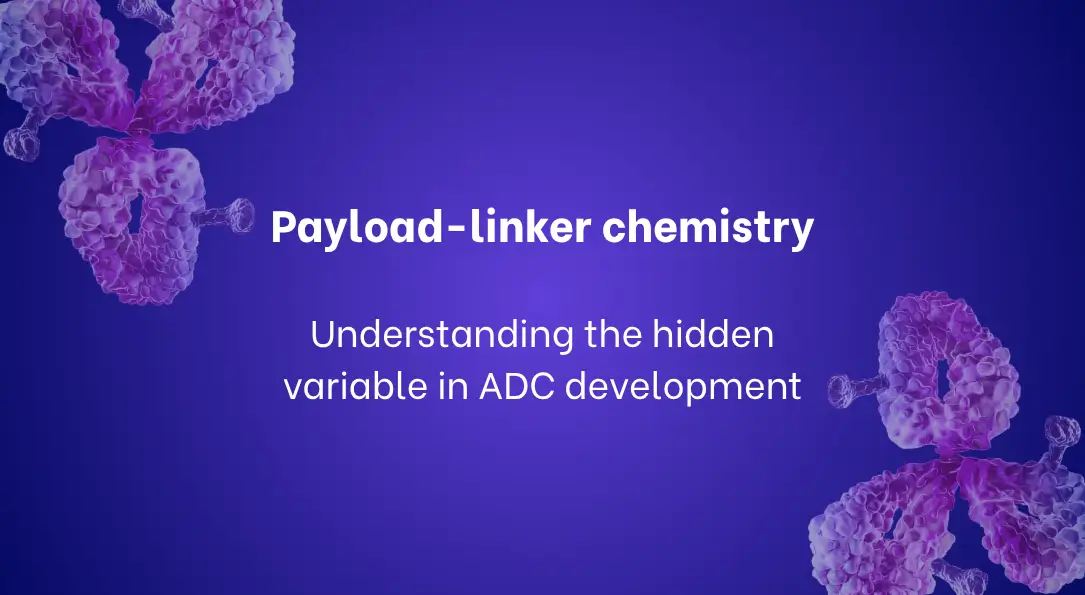
Antibody development is generally supported by mature platforms, established characterization methods, and easily transferable manufacturing processes. Payload–linker chemistry, however, is much less standardized. Each molecule requires a custom synthesis pathway and introduces unique impurity profiles, containment requirements, and analytical challenges. Additionally, because the linker affects how, when, and how much of the payload reaches the target site, its design directly affects the drug's efficacy and safety.
As a result, a significant portion of an ADC's clinical and regulatory risk is introduced during a chemical step that rarely receives the same industry attention as the underlying biology.
This article looks at why payload–linker chemistry is so demanding, what the clinical evidence tells us about the consequences of getting it wrong, why high-containment claims are less comparable than they may appear, and what to look for in a manufacturing partner.
Growing demand and a narrowing base
Industry trackers currently follow over 2,300 drug conjugates, with traditional ADCs making up the bulk of them (1,770 as of January 2026). While the clinically active pipeline is growing by roughly 20% annually, an even larger wave of molecules is building right behind it.1
Currently, 36% of all tracked ADCs are in active preclinical development. When these drugs move forward, the operational demands will increase dramatically. Of the ADCs that advanced a stage in 2025, 43% moved from preclinical into the clinic. This is the critical threshold where payload and linker chemistry graduates from a bench-scale research exercise into a strict GMP manufacturing requirement.2
Outsourced manufacturing is trying to scale in tandem. Estimates from Roots Analysis suggest the global ADC contract manufacturing market will jump from $1.72 billion in 2025 to $2.14 billion in 2026, eventually reaching $3.21 billion by 2035, with Europe capturing roughly 45% of the near-term market. Even factoring in variance across financial models, the upward trajectory is clear and steep.3
The main challenge, however, is that specialized capacity cannot be added as quickly as another conventional API line. The process requires high-containment infrastructure for potent payloads, complex linker synthesis, and highly specialized analytical controls. Recent industry data points to a global shortfall in specialized payload–linker synthesis capacity. Compounded by heavy capital requirements and notoriously slow technology transfers, this shortage is becoming a structural constraint on the entire sector's growth.4
The fundamental question for developers is thus whether the manufacturing base can absorb the sheer volume of molecules heading toward commercialization, as payload–linker chemistry remains the tightest bottleneck within that complex supply chain.
Where ADC complexity begins
It is easy to overlook the fundamental asymmetry of an ADC. Its three components serve distinct biological purposes, but they do not share the manufacturing burden equally.
Functionally, the roles are cleanly divided:
- The antibody navigates to the target.
- The linker ensures stability in the bloodstream and governs release.
- The payload dictates the mechanism of action.
Operationally, however, the linker and payload must first be fused into a single chemical entity before conjugation can even begin.
This payload–linker intermediate is the source of an ADC's most demanding chemistry. It is a bespoke molecule requiring a custom synthetic route, complete with its own unique impurity profile, analytical hurdles, and stringent high-containment requirements.
For drug developers, this structural divide becomes critical as soon as a program leaves the discovery phase. A sponsor can rely on a highly mature, standardized antibody platform, yet still face a completely different class of manufacturing hurdles to produce the payload–linker at scale.
Why potency changes the manufacturing equation
ADC payloads are typically 100 to 1,000 times more potent than traditional chemotherapy agents, with some molecules active in the sub-nanomolar or picomolar range. This potency is a crucial design requirement. Although the antibody directs the ADC toward cancer cells expressing its target, only a fraction of administered ADC reaches the tumor and successfully releases its payload.7 With typical drug-to-antibody ratios (DARs) of 2 to 8, each ADC carries a limited number of payload molecules.8 The payload must therefore be potent enough to kill target cells at very low intracellular concentrations.
On the manufacturing floor, however, that biological advantage becomes an operational hurdle. Producing these highly potent molecules requires occupational exposure controls far beyond those used for conventional APIs, making physical containment the defining feature of facility and process design.
The right engineering controls, however, depend on the molecule's specific toxicological profile, occupational exposure limits, manufacturing scale, and the precise unit operations being performed rather than a generic "ADC payload" classification.
As a result, successful payload–linker development forces manufacturers to balance three distinct disciplines simultaneously: complex synthetic chemistry, rigorous analytical control, and uncompromising containment.
The clinical stakes of linker chemistry
Linker design dictates an ADC’s stability, controlling exactly how and when the payload is released. If a linker degrades prematurely, the free toxic payload leaks into systemic circulation. This is far from a theoretical risk since a meta-analysis of 40 clinical trials and nearly 8,000 patients drew a straight line between free-payload exposure and toxicity, noting higher rates of severe (grade 3 or above) adverse events associated with cleavable linkers and higher drug-to-antibody ratios.5
Because of this direct link to clinical outcomes, payload–linker chemistry must be tightly governed before the conjugation step. When the payload–linker enters conjugation, it does so as a defined chemical intermediate. Its purity, consistency, and analytical profile essentially form the quality-control foundation for the final ADC.
That said, not every chemical anomaly carries through to the patient. The drug–linker intermediate typically accounts for just 5% to 6% of the final ADC by mass. Recognizing this, a 2025 multi-company consensus paper concluded that organic impurities at or below 1.0% w/w in the intermediate are highly unlikely to cause adverse effects in the finished drug.6
However, the same paper stressed that drug–linker manufacturing remains the most practical checkpoint for catching and controlling these variables. When dealing with compounds this potent, managing impurities is a crucial safeguard for patient safety, even if only a fraction ever makes it into the final conjugate.
What specialized manufacturing actually requires
- Engineered-in containment
High-potency payloads cannot simply be dropped into a standard API suite. Containment must be engineered around the specific compound, process, and exposure risks of each operation. This requires purpose-built controls, such as isolators, closed transfers, pressure differentials, and specialized air-handling systems.
Crucially, these controls must be proven exactly where the material is exposed. Charging, milling, drying, sampling, and packaging each present unique physical challenges. A facility equipped to safely handle one operation is not automatically qualified for the others.
- Analytical control as a strategic asset
For drug–linker intermediates, robust analytical capability acts as the gatekeeper before conjugation. So it is about more than just releasing a batch. While standard organic impurities are managed under ICH Q3A guidelines, mutagenic impurities fall under ICH M7. This means they must be controlled against strict acceptable intake limits rather than simple percentage thresholds, requiring highly sensitive analytical methods.
- Securing capacity ahead of the curve
Sponsors cannot assume specialized payload–linker capacity will be waiting for them the moment their program advances. High-potency manufacturing demands custom equipment, rigorous facility qualification, and highly trained personnel. This type of infrastructure takes significant time to bring online.
Partnering with a manufacturer that can scale seamlessly from early development through commercial GMP supply eliminates the costly, disruptive site changes often required as a program matures.
Looking beyond the OEB label
A "high containment" claim tells very little on its own. Neither does an Occupational Exposure Band (OEB) rating. OEBs are internal hazard-classification tools, not standardized industry metrics. Because different organizations use different banding systems and thresholds, these labels are nearly impossible to compare across facilities.
An Occupational Exposure Limit (OEL) provides a far more useful, quantified target. Yet, even an OEL is only part of the equation. When evaluating a manufacturing partner's true capabilities, sponsors should ask three specific questions:
- What exact OEL is the facility designed to meet?
- For which specific unit operations has this containment performance actually been demonstrated?
- Are these controls physically engineered into the process, or does the facility rely heavily on standard operating procedures and PPE?
The answers to those questions reveal considerably more than the OEB 6 label.
Polpharma API: From payload–linker chemistry to GMP supply
Polpharma API develops and manufactures payload–linkers, oligonucleotides, and small-molecule APIs at a single, fully integrated site in Starogard Gdański, Poland. With a manufacturing legacy dating back to 1951 and a track record of successful FDA inspections since 2004, the facility is built on a deep foundation of chemical expertise.
Uncompromising containment
Built to handle extreme potency, the facility is designed to meet an OEL of 10 ng/m³. It features two specialized kilo labs rated below 1 µg/m³, utilizing isolators and split butterfly valves for safe, contained charging. Dispensing, isolation, drying, milling, and packaging are all performed under strict enclosure.
Deep analytical capabilities
A dedicated team of over 85 R&D specialists supports the manufacturing process from end to end. The site is equipped with a comprehensive suite of in-house testing technologies, from advanced chromatography (HPLC/UPLC, LC-MS, GC) to solid-state characterization (XRPD, DSC, TGA) and rigorous microbiological analysis.
Right-sized scope and scale
Polpharma focuses its expertise entirely on the payload–linker intermediate, seamlessly handing off the finished chemical entity to partner organizations for antibody production and conjugation. High-potency payload–linker manufacturing is executed at the kilo-lab scale, accommodating batches up to 3 kg and supporting cryogenic chemistry down to −80 °C.. For broader small-molecule needs, the wider site offers extensive pilot and commercial API manufacturing, using 227 reactors to scale from 40 kg up to 800 kg.
Case in point: Celon Pharma
Putting these capabilities into practice, Celon Pharma recently selected Polpharma API to develop and manufacture an MMAE-based payload–linker under GMP conditions. Designed for a novel ADC targeting solid tumors, this material will be conjugated with a monoclonal antibody to supply upcoming Phase I clinical trials.
The manufacturing base matters
The scientific momentum behind ADCs is undeniable, but it must be matched by a manufacturing base that can deliver them. The payload–linker remains one of the supply chain's most demanding hurdles, as the critical juncture where advanced chemistry, rigorous containment, and strict GMP control must align perfectly.
Contact our experts to discuss how Polpharma API can support your payload–linker program from initial route development and containment strategy through to reliable GMP supply.
Sources:
1-2. ChemExpress. Antibody–Drug Conjugate Landscape Review 2025.
https://www.chemexpress.com/news-and-events/news/191
3. Roots Analytics. ADC Contract Manufacturing Market: Forecast 2026 to 2035.
https://www.rootsanalysis.com/reports/adc-contract-manufacturing-market/218.html
4. PharmaSource. ADC Antibody Drug Conjugates: CDMO Manufacturing Services & Market Report 2026.
https://pharmasource.global/content/antibody-drug-conjugates-adc-contract-manufacturing-market/
5. Cancer and Metastasis Reviews. 2025. Influence of antibody–drug conjugate cleavability, drug-to-antibody ratio, and free payload concentration on systemic toxicities: A systematic review and meta-analysis.
https://link.springer.com/article/10.1007/s10555-024-10231-5
6. Regulatory Toxicology and Pharmacology. 2026. Impurity qualification requirements for drug-linkers related impurities used to generate antibody-drug conjugates.
https://www.sciencedirect.com/science/article/abs/pii/S0273230025002065
7. Colombo, R. et al. 2024. The Journey of Antibody–Drug Conjugates: Lessons Learned from 40 Years of Development. https://aacrjournals.org/cancerdiscovery/article/14/11/2089/749211/
8. Wang, R. et al. 202.5 Antibody–Drug Conjugates (ADCs): current and future biopharmaceuticals.
https://link.springer.com/article/10.1186/s13045-025-01704-3