Articles
Follow our developments and deepen your industry knowledge by following our updates and news.
The Rise of Precision Oncology

Precision oncology is reshaping not only how cancer therapies are developed, but also how pharmaceutical portfolios and supply chains are built. As patient populations become more precisely defined, the market is shifting toward specialized products, smaller volumes and increasingly complex manufacturing requirements. What does this mean for API manufacturers—and which capabilities will define competitiveness in the next generation of oncology?
The Market Shift Reshaping Oncology Drug Landscape
Over the past two decades, oncology has become one of the most dynamic areas of pharmaceutical innovation. Advances in molecular science, diagnostics and drug discovery have transformed the way new therapies are developed, moving the industry beyond traditional "one-size-fits-all" approaches. Today, cancer is increasingly understood as a collection of biologically distinct diseases rather than a single condition defined solely by its location in the body.
This shift is reshaping the oncology landscape. Drug developers are focusing on increasingly specific patient populations, and precision medicine is becoming one of the key forces shaping the future of oncology drug development.
For the pharmaceutical industry, this evolution extends far beyond the clinic, influencing portfolio strategy, manufacturing requirements, regulatory expectations and the capabilities needed across the supply chain. Understanding these changes is essential for companies looking to participate in the next generation of oncology innovation.
Why "One Cancer" Is No Longer One Disease
For decades, cancers were primarily classified by the organ in which they originated. Breast cancer, prostate cancer, or lung cancer were often viewed as relatively uniform diseases, and new therapies were typically developed for broad patient populations. Today, advances in molecular research and diagnostic technologies are revealing a far more complex picture.
What was once considered a single disease may actually consist of multiple biologically distinct subtypes driven by different mechanisms. Two patients with the same cancer diagnosis can have tumors with very different genetic profiles, disease progression patterns, and responses to therapy. As a result, the industry's understanding of cancer is shifting from an organ-based view to a more nuanced, biology-driven approach.
This evolution is changing how pharmaceutical companies identify opportunities, design clinical development programs, and build commercial strategies. Rather than focusing solely on large patient populations, companies are increasingly exploring therapies for smaller, more defined segments. The result is a growing number of targeted development programs, greater portfolio specialization, and a market that looks fundamentally different from the oncology landscape of just two decades ago.
Precision medicine emerged as a response to this new understanding. Instead of asking whether a therapy is suitable for all patients with a given cancer type, we are increasingly asking which patients are most likely to benefit based on the biological characteristics of their disease.
Precision Medicine Is No Longer a Niche
Precision medicine was considered a promising but relatively specialized segment of oncology. But today, it has become one of the defining trends shaping pharmaceutical innovation. Growing scientific knowledge, advances in diagnostic capabilities, and the increasing ability to identify distinct patient subgroups have fundamentally changed how new oncology therapies are discovered, developed and commercialized.
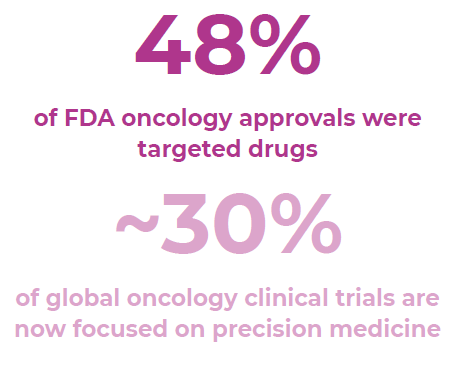
This shift is reflected across the industry. Clinical development programs are becoming more focused, targeted therapies account for an increasing share of new oncology approvals, and biomarker-driven approaches are now integrated into a growing proportion of clinical trials. From January 2000 to October 2022, the FDA approved 573 oncology indications, of which 48% were targeted drugs, 43% biological therapies, and only 9% cytotoxic treatments [1]. Moreover, approximately 30% of global oncology clinical trials are now focused on precision medicine approaches.[2]

The implications extend beyond drug discovery. Precision medicine is changing how companies evaluate market opportunities, allocate R&D resources and build future portfolios. Competitive advantage increasingly depends on specialized manufacturing requirements and flexibility across development and supply.
This evolution is creating new opportunities across the pharmaceutical value chain while raising the bar for development, manufacturing, analytical capabilities and regulatory expertise.
Four Market Trends Driving Precision Oncology
1. Smaller patient populations, more products
One of the most visible consequences of precision medicine is the shift from large, broadly defined patient populations toward increasingly specialized segments. As researchers gain a better understanding of the biological diversity within individual cancer types, new therapies are being developed for narrower groups of patients.
This trend is fundamentally changing the structure of the oncology market. It is becoming increasingly fragmented, with a growing number of specialized products targeting specific disease subtypes or molecular profiles. While individual patient populations may be smaller, the total number of development opportunities continues to expand.
For pharmaceutical companies, this means managing larger and more diverse portfolios. For the broader value chain, it translates into a growing volume of product launches, shorter commercial scales, and increasing demand for flexibility across development, manufacturing and supply operations.
This transition creates new opportunities, but also operational challenges throughout the pharmaceutical supply chain.
2. Growing importance of diagnostics and patient stratification
The ability to identify specific patient subgroups is becoming an integral part of the development process. Diagnostic tools and biomarker testing are playing a growing role in clinical research, helping companies focus development efforts on more narrowly defined populations. This shift is influencing how clinical trials are designed, how therapies are positioned, and how future market opportunities are evaluated.
3. Rising demand for highly specialized APIs
As precision oncology advances, the requirements placed on API development and manufacturing are becoming increasingly sophisticated. Many nextgeneration oncology therapies involve highly potent compounds, complex synthetic routes and demanding analytical requirements, creating a growing need for specialized capabilities across the supply chain.
This trend is particularly visible in the expanding role of High Potency APIs (HPAPIs), which have become a key component of modern oncology portfolios. At the same time, manufacturers are facing increasing expectations related to containment, impurity control, advanced analytical characterization and process robustness.
For API suppliers, precision oncology is not only creating demand for new molecules. It is also raising the bar for the technical and operational capabilities required to bring these products to market. As oncology pipelines continue to evolve, expertise in HPAPI development and manufacturing is becoming an increasingly important differentiator across the industry.
4. Portfolio specialization
As the oncology market becomes increasingly segmented, portfolio strategies are evolving as well. Many companies are expanding into multiple niche and specialty therapies addressing specific patient populations, supporting more diversified development pipelines. For the pharmaceutical supply chain, this means supporting products with different manufacturing, regulatory and commercial requirements, often at smaller scales than traditional blockbuster therapies.
The impact extends beyond innovator companies. Generic manufacturers, API suppliers, CDMOs and the broader pharmaceutical supply chain are adapting their development priorities, manufacturing strategies and investment decisions to this more specialized market environment.
For the pharmaceutical value chain, this means balancing specialization, flexibility and technical expertise with scale.
What Precision Medicine Means for API Manufacturers
While precision medicine is often discussed in the context of drug discovery and clinical developments, these market shifts translate into specific technical, operational and regulatory demands for API manufacturers.
More Potent Molecules
Many modern oncology therapies fall into the High Potency API (HPAPI) category, requiring specialized facilities, containment systems and handling procedures. As precision oncology continues to grow, demand for HPAPI capabilities is expected to increase, making containment expertise and occupational safety key differentiators across the industry.
Greater Analytical Complexity
The growing sophistication of oncology molecules is accompanied by increasing analytical challenges. Complex impurity profiles, stereochemistry, low-dose products and stringent quality expectations require advanced analytical methods and deeper process understanding. As a result, analytical development is becoming an increasingly important component of successful API programs.
Manufacturing Flexibility
Precision medicine is changing the economics of pharmaceutical manufacturing. Smaller patient populations often translate into lower production volumes and a larger number of niche products. Rather than focusing exclusively on large commercial campaigns, manufacturers must increasingly support flexible production models capable of handling multiple products and varying batch sizes.
Higher Regulatory Expectations
As therapies become more specialized, regulatory requirements continue to evolve. API manufacturers are expected to provide increasingly robust process knowledge, analytical justification and product documentation. Successfully supporting modern oncology products requires not only manufacturing expertise, but also strong development, quality and regulatory capabilities.
Together, these trends are reshaping what it means to be a competitive API supplier. In the era of precision oncology, technical expertise, flexibility and the ability to manage complexity are becoming just as important as scale and manufacturing capacity.
Inavolisib and Talazoparib: Examples of the Trend
Inavolisib and Talazoparib illustrate how oncology innovation is moving toward development programs for more narrowly defined patient populations. While the underlying scientific approaches differ, both molecules reflect greater market segmentation and portfolio specialization.
Inavolisib
Breast cancer is one of the most common cancers worldwide, with approximately 2.3 million new cases diagnosed annually. [3]
Inavolisib illustrates how precision oncology is moving toward increasingly specialized patient populations. While breast cancer affects millions of patients globally, the therapy has been developed for a much narrower molecularly defined subgroup. Approximately 35-40% of HR+/HER2- breast cancers carry a PIK3CA mutation [4], highlighting how advances in molecular understanding are creating opportunities for more targeted development programs.
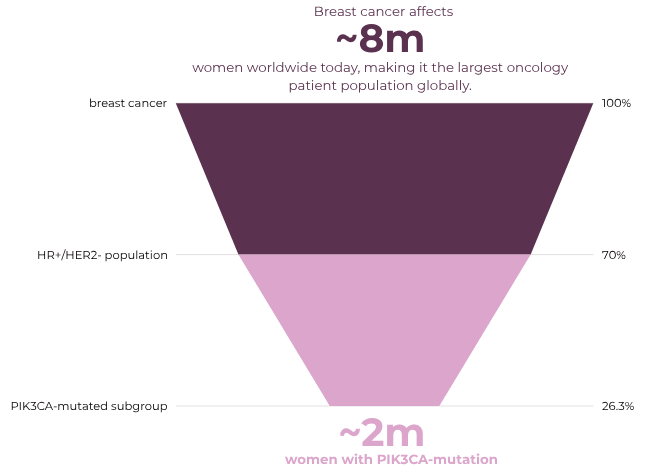
From approximately 8 million women living with breast cancer worldwide, around 5.6 million belong to the HR+/HER2- subtype, and roughly 2.1 million carry a PIK3CA mutation. This evolution toward increasingly specialized patient populations is creating new opportunities across the oncology value chain, including the development of highly specialized APIs.
Talazoparib
Prostate cancer is the most commonly diagnosed cancer in men, with approximately 1.4-1.5 million new cases globally every year. [5]
Talazoparib reflects a similar trend toward increasing specialization. Rather than addressing the entire prostate cancer population, development programs focus on patients with specific defects in DNA damage repair pathways. Studies suggest that BRCA1/2 alterations are present in roughly 12% of metastatic hormone-sensitive prostate cancer patients, with a broader set of homologous recombination repair (HRR) alterations observed in nearly 30% of patients. [6]
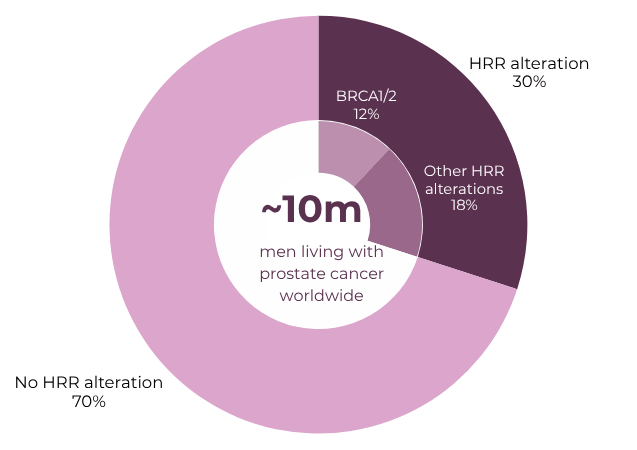
While prostate cancer affects millions of men worldwide, treatment decisions are increasingly guided by the molecular characteristics of much smaller patient subgroups.
Together, these examples show how oncology is evolving from broad disease categories toward increasingly specialized patient populations, creating new opportunities for targeted innovation across the healthcare ecosystem.
The Future of Oncology
Although precision medicine is still evolving, further segmentation of patient populations and portfolio specialization are likely to remain defining features of oncology development.
For the pharmaceutical industry, this shift goes far beyond the introduction of new therapies. Precision oncology is influencing how companies prioritize development programs, evaluate market opportunities and build long-term portfolio strategies. At the same time, the growing importance of highly potent and technically demanding molecules is expected to further increase demand for specialized API capabilities, particularly in the HPAPI segment.
These changes are creating new expectations not only for innovator companies, but for the entire pharmaceutical ecosystem. API manufacturers, CDMOs, generic companies and supply chain partners will need to operate in an environment characterized by greater complexity, smaller production volumes, more diversified portfolios and increasing regulatory scrutiny.
For companies across the pharmaceutical value chain, the ability to support specialized products and adapt to evolving market needs will be an increasingly important driver of long-term competitiveness.
Connect & Collaborate
Polpharma API
For more information on how Polpharma API can be your strategic ally in drug substance development, contact us
Let's embark on a journey of innovation and excellence together.
Author

Product Manager
Polpharma API BU
[1] Trends in FDA-Approved Cancer Therapies
[2] Novotech-WhitePaper-Precision-Oncology.pdf
[3] Breast cancer – IARC
[4] Breast cancer – IARC
[5] Prostate cancer: Navigate your journey with information, resources and support you can trust | Movember
[6] BRCA1/2 and homologous recombination repair alterations in high- and low-volume metastatic hormone-sensitive prostate cancer: prevalence and impact on outcomes - Annals of
Oncology
Disclaimer
Products protected by patents (SPC) in Poland are developed solely for the purpose of Regulatory Submissions or R&D purposes intended to support Regulatory Submissions. These products
are not offered for sale or made available in countries where such products are subject to patent (SPC) protection and where the offer for sale or any related activity constitutes patent
infringement. It is within the buyer’s responsibility and liability to check the patent situation of the product in the import market(s).