Articles
Follow our developments and deepen your industry knowledge by following our updates and news.
Understanding the Oligonucleotide Market: A Foundation for Next‑Generation API Capabilities
.webp)
Oligonucleotides are becoming one of the fastest‑growing API segments, driven by strong pipeline expansion and rising demand for high‑purity, GMP‑grade manufacturing. This overview highlights key market trends, core technologies, and Polpharma API BU’s proven capabilities — including Nusinersen production — that position us to support customers entering or scaling in the oligo space.
Why Oligonucleotides Matter Today
Oligonucleotides have evolved from specialized laboratory compounds into a key molecular platform supporting modern biotechnology, diagnostics, and RNA-driven innovation. Their highly programmable nature, rapid design cycles, and compatibility with numerous modalities make them integral to the expanding nucleic-acid ecosystem.
Global activity reflects this shift. The use of synthetic oligonucleotides is now deeply embedded in research and analytical workflows: nearly half of R&D programs rely on them, while over half of diagnostic platforms incorporate oligo-based elements to enable high-precision molecular analyses [1].
Although oncology remains the most established and sizable pharmaceutical R&D domain, the pace of development within oligonucleotide-based technologies is accelerating quickly. Importantly, oligonucleotides do not belong to the oncology category — they span a wide range of applications across research, diagnostics, genetic modulation, and multiple therapeutic areas.
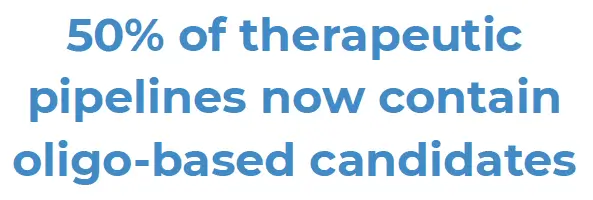
Industry assessments indicate that more than 50% of therapeutic pipelines now contain oligo-based candidates, underscoring their strategic rise [2], reflecting a rapid shift toward nucleic-acid-driven modalities.
Meanwhile, the oligonucleotide API market is expanding at compound annual growth rates (CAGR) between 5.6% and nearly 10%, depending on methodology and scope [3], surpassing the growth rate of several mature oncology subsegments that have begun to plateau as competition intensifies. This acceleration demonstrates that oligonucleotides — once considered a niche technology — are now scaling at a rate comparable to one of the industry’s most dominant therapeutic categories, underscoring their emerging strategic importance for API manufacturers.
What Exactly Are Oligonucleotides?
Oligonucleotides are short-chain fragments of DNA or RNA. DNA-based structures typically exist as double-stranded (forming a double helix) whereas RNA-based structures are usually single-stranded. They are naturally formed via enzymatic synthesis within human organs but can also be synthesized in laboratories. Thus, one can distinguish between native and artificially designed oligonucleotides with various properties including regulation of gene expression, participation in encoding and transmitting of genetic information or involvement in replication, transcription and translation processes [4].
A breakthrough of great importance was made at the end of 20th century. Following the sequencing of the human genome along with the development of novel research and analytical methods, a new approach comprising precise targeting of specific genetic material and treating diseases at a molecular level was proposed. The antisense oligonucleotide (ASO) strategy fits perfectly into this methodology and opens up the possibility of delivering targeted drugs for rare and incurable diseases, based on sequences 12–25 nucleotides in length [5].
One example of such medicines is FDA-approved Nusinersen, an 18-mer ASO orphan drug specifically designed to treat spinal muscular atrophy and the very first oligonucleotide to be produced in Polpharma API BU [6].
Market Momentum & Growth Factors
Across both API and synthesis segments, the oligonucleotide market shows consistent and robust growth, reinforcing its relevance for organizations planning capability expansion.
- The global oligonucleotide API market is projected to increase from USD 3.0 billion in 2025 to USD 5.1 billion by 2035, reflecting a CAGR of approximately 5.6% [7].
- Certain market models predict even stronger growth — reaching USD 7.75 billion by 2035 from a 2025 baseline of USD 3.07 billion, corresponding to CAGRs above 9.7% [8].
- The oligonucleotide synthesis market, which feeds API manufacturing pipelines, was valued at USD 3.64 billion in 2025 and is forecasted to rise to USD 10.86 billion by 2033, driven by sustained annual growth near 15% [9].
Key drivers behind this momentum include:
- The rapid expansion of RNA-centered and gene-modulation technologies requiring custom or large-scale oligo inputs.
- Growing biopharma investment in genomics and molecular biology, integrating oligos into discovery workflows.
- Increasing demand for molecular diagnostics, where oligos serve as primers, probes, and reference controls.
- Rising outsourcing trends, highlighting the need for GMP-grade, scalable API supply partnerships.

Technological Shift & Manufacturing Needs
As the field matures, the requirements placed on manufacturers have intensified. Demand is moving from research-grade oligos to clinical- and commercial-scale API production, which introduces new expectations regarding consistency, control, and regulatory compliance.
Market reports highlight:
- There is a clear movement toward longer, more complex, and chemically modified oligos, pushing manufacturers to adopt advanced synthesis and purification technologies. In the U.S., uptake of antisense, siRNA, and aptamer-based technologies has grown by more than 42%, driving expansion of high-precision synthesis capacity [10].
- Automation and modern purification capabilities are rapidly becoming industry standards, with automated synthesis tools achieving over 41% uptake and enhanced purification strategies improving quality by approximately 40% [11].
- Forecasts position the synthesis market on track to exceed USD 50.84 billion by 2034, fueled by demand for high-purity, custom, and fully compliant oligo products [12].
To keep pace, manufacturers must ensure that:
- Production lines support high-purity output and modified chemistries
- Automated synthesis and purification are deployed for robustness and scalability
- Supply chains can maintain reliable access to critical reagents
- GMP frameworks effectively support regulated oligo APIs
Taken together, these developments explain why established pharmaceutical producers and CDMOs are expanding or modernizing their oligo-dedicated facilities.
General Production & Synthesis of Oligonucleotides
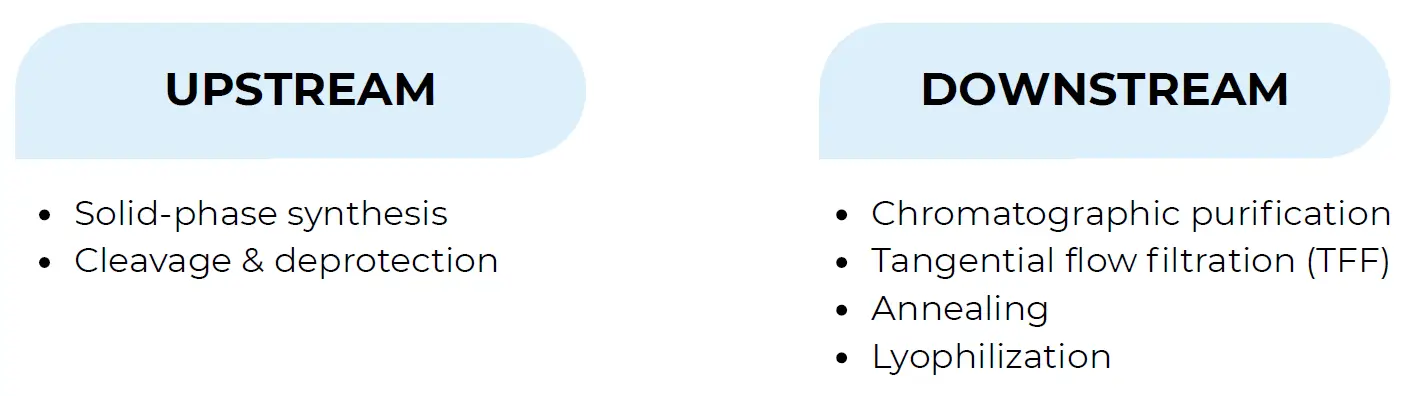
Generally, oligonucleotides are produced in a multi-step procedure [13] that covers the so-called upstream and downstream stages:
Case study: Nusinersen — first oligonucleotide produced at Polpharma API BU
Solid-phase synthesis requires the use of an oligonucleotide synthesizer, a column, a solid support, phosphoramidites (building blocks) and auxiliary reagents. Inside the column, an oligonucleotide grows on the solid support leading block by block to a full length product (FLP).
Taking Nusinersen as an example, the synthesis comprises 18 synthetic cycles, each consisting of 4 independent steps separated by solvent washings. After work-up, the FLP is released from the solid support via base hydrolysis and is directed to chromatographic purification. Why use such a sophisticated technique for purification? The answer is simple: the crude solution is a very complex mixture of FLP accompanied by various impurities, mostly shorter or longer sequences and their derivatives. Using classic purification methods like extraction or crystallization would make it impossible to isolate a compound of the desired purity. After chromatographic purification, the Nusinersen solution is transferred to the three-module TFF system where concentration, desalting and removal of endotoxins take place. Similarly to chromatography, TFF is not comparable to any other classic purification techniques and is based on different phenomena. The heart of this process is ultrafiltration cassettes possessing special membranes that either permit Nusinersen to pass or retain it. After TFF, the Nusinersen solution is poured into disposable plastic trays and the final product is isolated via lyophilization.
Why New Capabilities Are Essential
Despite strong market growth, the sector faces several performance bottlenecks that create a clear opportunity — and necessity — for enhanced manufacturing capabilities:
- Capacity limitations: As oligo pipelines scale, GMP manufacturing capacity struggles to keep pace.
- Increasing sequence complexity: Longer and more heavily modified oligos require extremely tight control over synthesis efficiency and impurity management. Data indicate that error rates for long sequences have risen by around 28%, highlighting the need for improved process control [14].
- Greater regulatory expectations: As oligos progress into advanced development stages, reproducibility, compliance, and documentation requirements become significantly more demanding.
These pressures clearly justify continous investment in specialized oligo manufacturing capabilities, especially for suppliers aiming to serve high-growth segments in biotechnology and pharmaceuticals.
As demand accelerates and technical complexity grows, robust internal R&D and process development capabilities become essential for delivering high-quality, scalable oligo APIs.
Authors
.webp)
Senior Technologist
Technology Development Department
Polpharma API BU

Product Manager
Marketing
Polpharma API BU
[1] GlobalGrowthInsights. (2026, February 16). Oligonucleotide Synthesis Market Report 2026–2035. Retrieved March 10, 2026, from: https://www.globalgrowthinsights.com/market reports/101707
[2] Future Market Insights. (2025, October 27). Oligonucleotide API Market | Global Market Analysis Report – 2035. Retrieved March 10, 2026, from: https://www.futuremarketinsights.com/reports/oligonucleotide-api-market
[3] Research Nester. (2026, February 25). Oligonucleotide API Market Size | Global Forecast Report 2035. Retrieved March 10, 2026, from: https://www.researchnester.com/reports/oligonucleotide-api-market/4308
[4] Alberts, B., Johnson, A., Lewis, J., Raff, M., Roberts, K., & Walter, P. (2002). Molecular Biology of the Cell. Garland Science: NY
[5] Radzikowska, E., Kaczmarek, R., & Baraniak, J. (2015). Wiadomości Chemiczne, 69(11), 957–981.
[6] Hederoth, G., Lyngå, O., Rudqvist, O., Jeppsson, R., Hogolof, S., Svanberg, S., & Kauppinen, V. (2022). Non‑coding RNAs as Therapeutic Agents: The Future of Therapy.
[7] Future Market Insights. (2025, October 27). Oligonucleotide API Market | Global Market Analysis Report – 2035. Retrieved March 10, 2026, from: https://www.futuremarketinsights.com/reports/oligonucleotide-api-market
[8] Research Nester. (2026, February 25). Oligonucleotide API Market Size | Global Forecast Report 2035. Retrieved March 10, 2026, from: https://www.researchnester.com/reports/oligonucleotide-api-market/4308
[9] Grand View Research. (2025). Oligonucleotide Synthesis Market Size & Share Report, 2033. Retrieved March 10, 2026, from: https://www.grandviewresearch.com/industry-analysis/oligonucleotide-synthesis-market
[10] GlobalGrowthInsights. (2026, February 16). Oligonucleotide Synthesis Market Report 2026–2035. Retrieved March 10, 2026, from: https://www.globalgrowthinsights.com/market-reports/101707
[11] GlobalGrowthInsights. (2026, February 16). Oligonucleotide Synthesis Market Report 2026–2035. Retrieved March 10, 2026, from: https://www.globalgrowthinsights.com/market-reports/101707
[12] Fortune Business Insights. (2026, March 2). Oligonucleotide Synthesis Market Size, Industry Share, and Analysis: 2026–2034. Retrieved March 10, 2026, from: https://www.fortunebusinessinsights.com/industry-reports/oligonucleotide-synthesis-market-101020
[13] Abe, A., & Časar, Z. (2025). Organic Process Research & Development, 29, 15–33.
[14] GlobalGrowthInsights. (2026, February 16). Oligonucleotide Synthesis Market Report 2026–2035. Retrieved March 10, 2026, from: https://www.globalgrowthinsights.com/market-reports/101707
Disclaimer
Products protected by patents (SPC) in Poland are developed solely for the purpose of Regulatory Submissions or R&D purposes intended to support Regulatory Submissions. These products are not offered for sale or made available in countries where such products are subject to patent (SPC) protection and where the offer for sale or any related activity constitutes patent infringement. It is within the buyer’s responsibility and liability to check the patent situation of the product in the import market(s).
.webp)